Understanding the Original Castings of Frederick Remington's Bronzes
 As a artist who has personally created multiple lost wax bronze sculptures, I often encounter a common misunderstanding about what constitutes an "original" bronze sculpture.
This confusion is particularly prevalent in discussions about Frederick Remington’s works, where many assume that only a single piece can be considered the original. In reality, the concept of originality in bronze casting is more nuanced.
The Original Sculpture and Mold Creation
 The true "original" of any bronze sculpture is the clay or wax piece that the artist sculpted by hand. This initial sculpture serves as the basis for creating a mold, which in turn is used to produce the bronze editions. The lost wax process begins by making a mold of the original sculpture. Hot wax is then poured into the mold and drained while still liquid, leaving a thin wax shell. The clay or wax "positive" is then coated in a ceramic shell, while the wax is burned out, leaving only the shell's thin, empty "negative" spaces to be filled by the molten bronze.
What Makes an "Original" Bronze Casting?
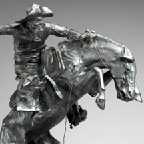
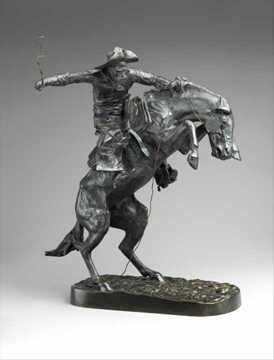
 The first castings made during the artist's lifetime—often referred to as the "original edition"—are highly valuable. These were created under the artist's supervision and carry their direct approval, making them the most sought-after by collectors and historians. For example, the version of The Bronco Buster that resides in the White House Oval Office is one of these original castings from Remington’s lifetime. Occasionally, these early castings appear on the market and command significant value due to their authenticity and historical significance.
The Fate of the Molds
The molds used for casting do not last forever. Over time, they deteriorate due to repeated use, making them unsuitable for further production. If the original wax sculpture remains intact, the artist may create a new mold to complete the edition.
However, after an artist’s passing, the creation of new molds is a different matter. In some cases, a family member or an authorized gallery may create an "authorized" mold from an early casting, leading to modern reproductions that, while desirable, are not part of the first limited editions made during the artist’s lifetime.
Quality and Authenticity in Bronze Casting
 Not all bronze sculptures are equal. Reputable foundries take great care in preserving the integrity of an artist’s work. However, later reproductions—especially unauthorized ones—may be made from different materials, such as alternative metals or even resin. These copies are often more affordable but lack the same historical and artistic value as authentic bronze castings.
True bronze sculptures are hollow, a necessity to prevent shrinkage and distortion in the metal as it cools. The entire process is expensive, requiring skilled craftsmanship at every stage. This is why bronze sculptures created during an artist’s lifetime by a well-known foundry hold such prestige—they retain the artist’s imprimatur through each step of the process.
Evaluating a Bronze Sculpture’s Provenance
 Understanding when a casting was made and which foundry produced it is crucial in determining its value. Each foundry has unique methods and materials, which can significantly impact the final sculpture. I have worked with three different foundries over the years, and the differences in technique and material quality have been striking.
A Lasting Legacy
Watching a program on the White House years ago, I was intrigued when the presenter pointed out that The Bronco Buster in the Oval Office was indeed one of Remington’s original castings. Having experienced the lost wax process firsthand, I understood the significance of such a piece. Bronze casting is a costly but enduring method that allows an artist's vision to be enjoyed by future generations—just as Remington’s work continues to inspire more than a century after its creation.
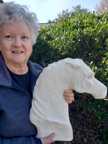
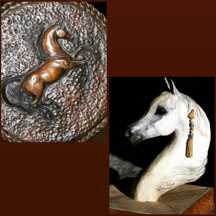
Images of Stacey's porcelain unicorn and her sculpture in progress provided by the author.
Frederick Remington sculpture photos courtesy of Wikipedia.